


Key takeaways:
- The first in Pearson’s Mind the Gap blog series explores how real AI ROI comes from CHROs and CTOs designing work together, not from deploying tools and hoping productivity follows.
- Breaking roles into tasks and aligning on a shared skills strategy accelerates adoption and reduces friction.
- Treating AI agents like accountable digital agents, with clear guardrails and human decision points, enables ethical augmentation at scale.
Mind the Learning Gap: Introducing a new Pearson blog series
The learning gap is the widening space between the speed of AI and the pace of human adaptation. Technology is advancing faster than organizations, economies, and people can keep up – and that gap is now one of the biggest constraints on productivity, competitiveness, and human potential.
Based on Pearson’s research, this Mind the Learning Gap blog series explores why learning, not technology, is the missing link in AI’s productivity promise. The series examines how leaders can embed learning into the flow of work to turn AI investment into real, sustained growth.
Across each blog, Pearson leaders share what they’re seeing, hearing, and solving as AI reshapes work at speed. This series is a practical guide to redesigning work so that people and intelligent systems grow together—and no one is left behind.
We start the series with Pearson's Chief Human Resources Officer (CHRO), Ali Bebo, and Pearson's Chief Technology Officer (CTO), Dave Treat, as they explore how to design a workforce led by people, and powered by technology. Over to Ali and Dave...
The CHRO and CTO: Rewiring how organizations unlock AI value
Across industries, organizations are investing in AI, yet many struggle to translate that investment into measurable productivity or growth. The hardest part of AI transformation isn’t the model; it’s the design of the work. The real transformational challenge is organizational.
That’s why one of the most pivotal partnerships today is between the CHRO and the CTO. At Pearson, we’ve seen first‑hand how bringing these two functions together—early, deliberately, and structurally—changes the entire trajectory of AI adoption.
The old model of “deploy tech, then train people” simply can’t keep pace with modern transformation cycles. Instead, HR and Technology must design for augmentation as one system: HR operating like a product organization, and Technology managing intelligent agents with the same accountability frameworks used for human talent.
That means redesigning roles into tasks, identifying where AI meaningfully augments human capability, and being explicit about where human judgement and connection must remain central.
This shift is what moves AI from experimentation to enterprise impact. And it’s what ensures AI strengthens peoples’ work rather than complicates it.
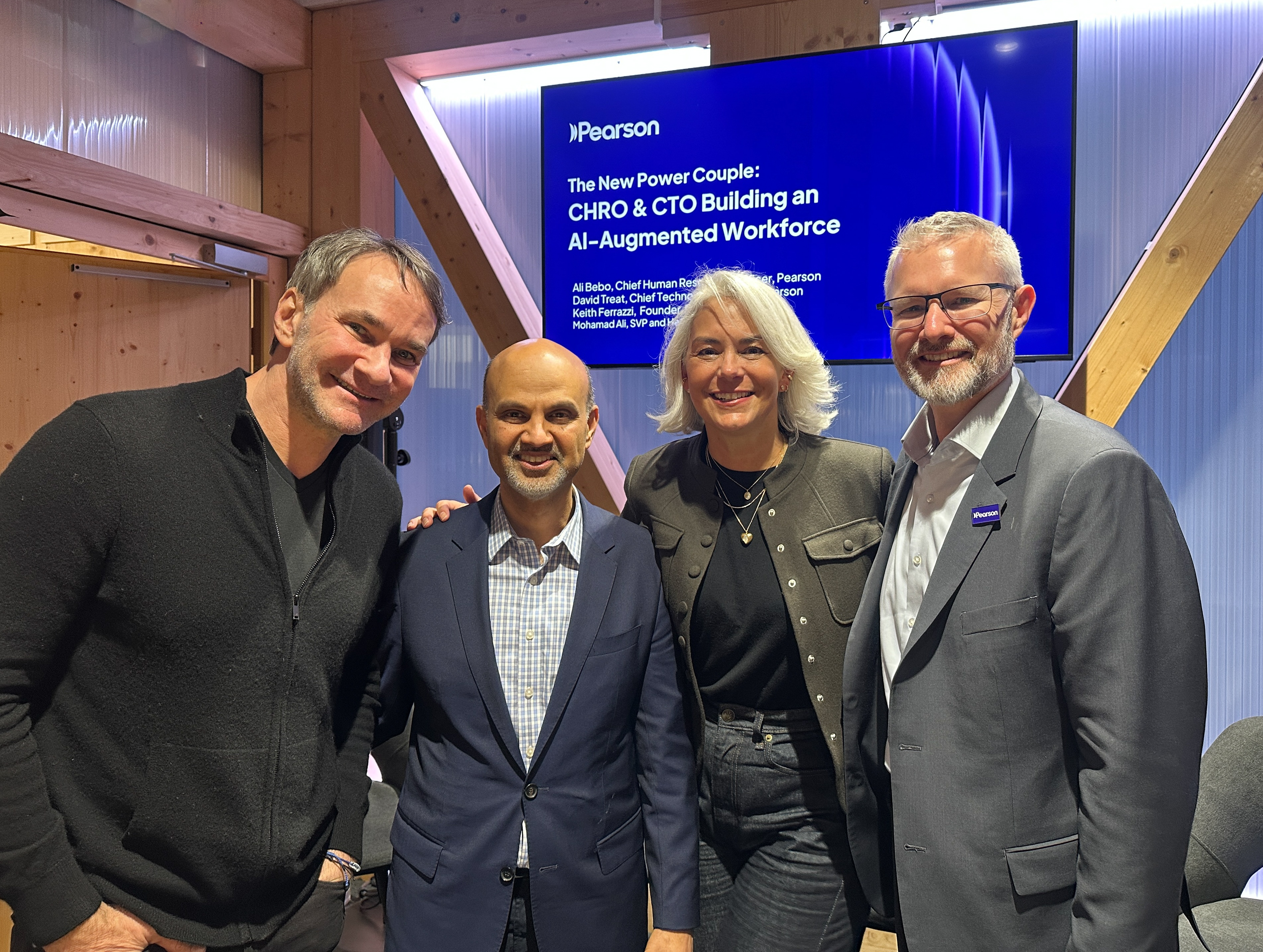
Ali Bebo and Dave Treat host a CHRO + CTO New Power Couple panel at WEF in Davos
One operating model: Where product engineering, HR, and skills speak the same language
Pearson’s approach starts by breaking one of the most persistent silos in corporate life: the separation between where technology is built and where it is used.
When product engineers and HR leaders collaborate early, workflows are designed with end-users in mind and not retrofitted after the fact. Adoption improves because employees see where technology helps them do their jobs better, not just faster.
The foundation underneath this is a common skills ontology that lets us map today’s capabilities to tomorrow’s demands. It enables clearer workforce planning. And it helps organizations avoid the trap of automating roles instead of elevating them.
At the same time, technology leadership shifts its mindset too. AI agents are not simply tools deployed into workflows. They are forms of digital labor that require clear responsibilities, performance metrics, and guardrails. When you define those things explicitly, managers know how to lead in this new environment, and employees understand where they add unique value. Trust comes from clarity, not hype.
What this looks like in practice: Augmentation that scales
This approach is already shaping how we operate across Pearson’s global workforce.
When CHROs and CTOs jointly own work redesign, capability building and architecture, leaders can answer the questions that matter:
Where does AI remove friction?
How does that free people to focus on higher‑value work?
How do we measure the impact?
With the right operating system in place, AI shifts from “interesting experiments” to “system‑level performance improvements.” Employees gain the skills they need in real time. Managers get clarity. Intelligent agents take on the right work. And the organization moves faster, with greater confidence and less risk.
This is what an AI‑augmented organization looks like: people combining their unique skills with intelligent systems to raise performance across the board.
Where leaders go from here
Pearson’s Mind the AI Learning Gap research shows that AI could unlock $6.6 trillion in economic value, but only if learning keeps pace with technological change.
CHROs and CTOs who build a unified strategy that is rooted in product thinking, shared skills data, learning, and responsible agent management will be the ones who capture AI’s full potential. Everyone else will stay stuck in pilot mode.
Pearson is proving what’s possible when the “Power Couple” leads together.
Close the learning gap with us. Read the report
----------

Ali Bebo is Pearson’s Chief Human Resources Officer

Dave Treat is Pearson’s Chief Technology Officer