


Key takeaways:
- Learning breaks down when data cannot move with the learner across education and work.
- Fragmented skills and credential data weakens trust and slows hiring, mobility, and advancement.
- Learner-controlled digital wallets enable portable, verified proof of what people know and can do.

Pearson CTO Dave Treat
This month at ASU+GSV, I convened a small group of leaders from education, workforce, and technology to talk about a challenge that keeps surfacing in different forms: we have more learning data than ever before, yet less confidence in what it signals.
Institutions sell the promise of outcomes. Learners invest in skills they believe will translate into opportunity. Employers are shifting toward capability-based hiring. But the connection between learning and work continues to break down precisely when it matters most. The result is a gap that is no longer sustainable.
When learning data cannot move with the learner, the system breaks
Across education and the labor market, people accumulate skills, credentials, and experience over time. The issue is not effort or motivation. It is that evidence of learning is scattered across disconnected systems.
When someone applies for a job or looks to advance, they are often reduced to self reported claims. Employers, in turn, are asked to make high stakes decisions based on resumes that are increasingly easy to generate and increasingly difficult to trust. The result is more noise, less signal, and fewer opportunities for learners to differentiate themselves based on real capability.
This is a structural failure. When learning data cannot move with the learner, the system breaks at every transition point.
Why digital wallets are the right abstraction
Before joining Pearson, much of my career focused on digital identity and credentialing infrastructure in financial services and enterprise environments. Those sectors learned early that trust does not scale without shared infrastructure.
Education is now facing the same challenge. Moving from claims about learning to proof of learning requires verifiable signals that can be shared, verified, and reused across organizations over time.
That need is what drew me to Pearson. The combination of learning science, assessment, credentials, and workforce insight creates an opportunity to address this problem in a learner-first way, without fragmenting the ecosystem further.
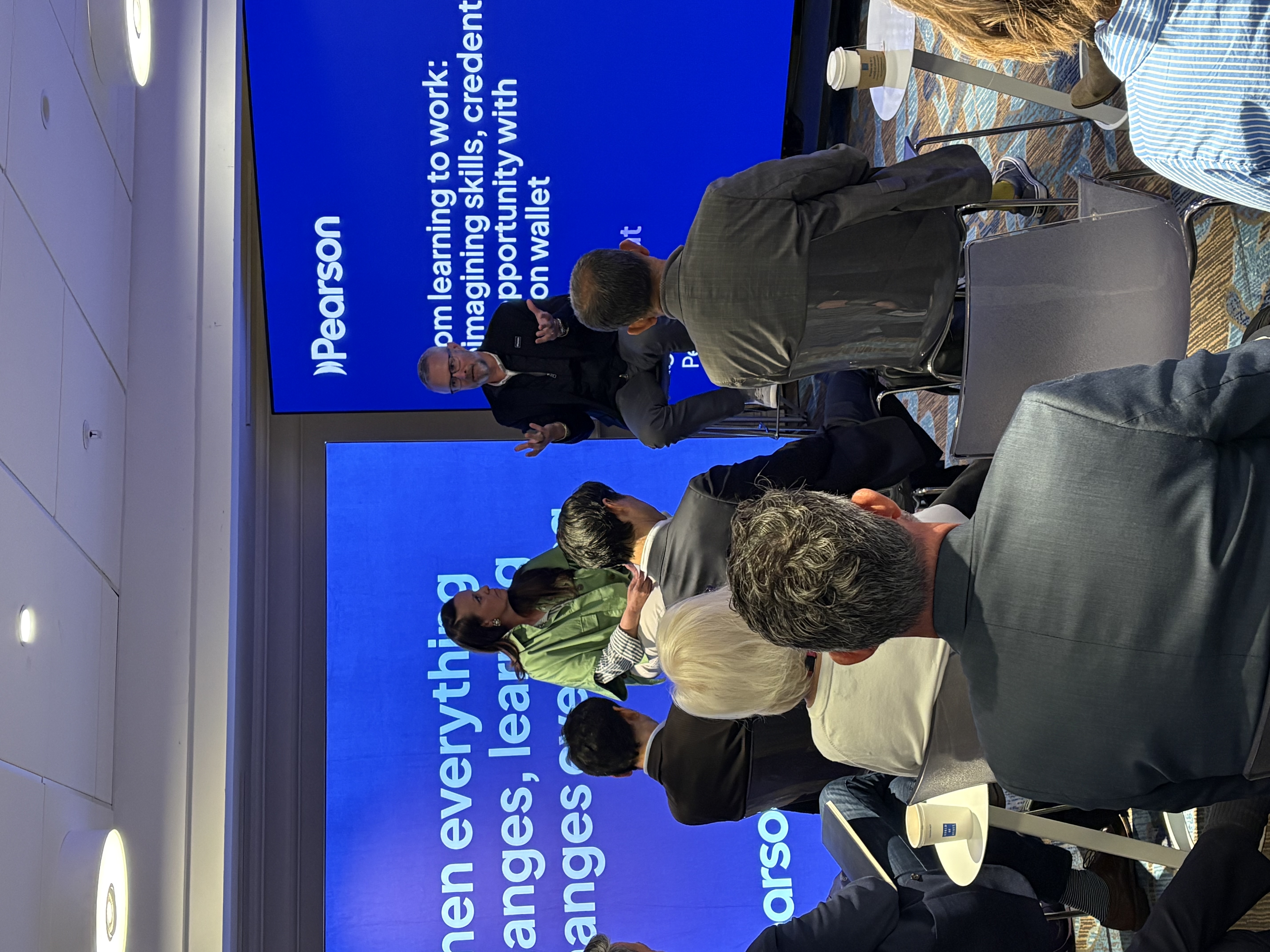
Dave Treat speaks at ASU + GSV
What a learner controlled wallet changes
During the discussion at ASU+GSV, I shared an early prototype of the Pearson Wallet grounded in a simple scenario: someone preparing for their first job or an early career move.
In this model, verified credentials, education records, and work based skills live together in a secure digital wallet controlled by the learner. Identity can be bound to credentials at issuance, and records are shared intentionally and selectively.
For employers and institutions, this means receiving verified credentials, standards based signals, and clearer visibility into outcomes. For learners, it provides something fundamental: portable proof of what they actually know and can do.
This is not about replacing resumes overnight. It's about building a more trustworthy foundation underneath them.
Why interoperability matters more than ownership
One point was clear in the discussion: no single organization should own the skills ecosystem.
For digital wallets to matter at scale, they must work across institutions, employers, and public systems. That requires open standards, interoperability, and shared governance. Closed loops might move faster at first, but they ultimately limit opportunity.
Several forces make this moment urgent. AI is reshaping work faster than education systems can adapt. Skills based hiring is becoming mainstream. At the same time, the cost of fragmented data continues to grow.
Pearson's approach reflects this reality. The goal is not to control the ecosystem, but to help build the infrastructure that allows it to function reliably, transparently, and at scale.
Looking ahead
What stayed with me most from ASU+GSV was not the technology, but how clearly the problem resonated across the room, even among those approaching it from very different angles.
If we get this right, the Pearson Wallet can help people access the opportunities they've earned. We can help employers hire with greater confidence. And they can help education systems better demonstrate their impact.
That's the work ahead.